
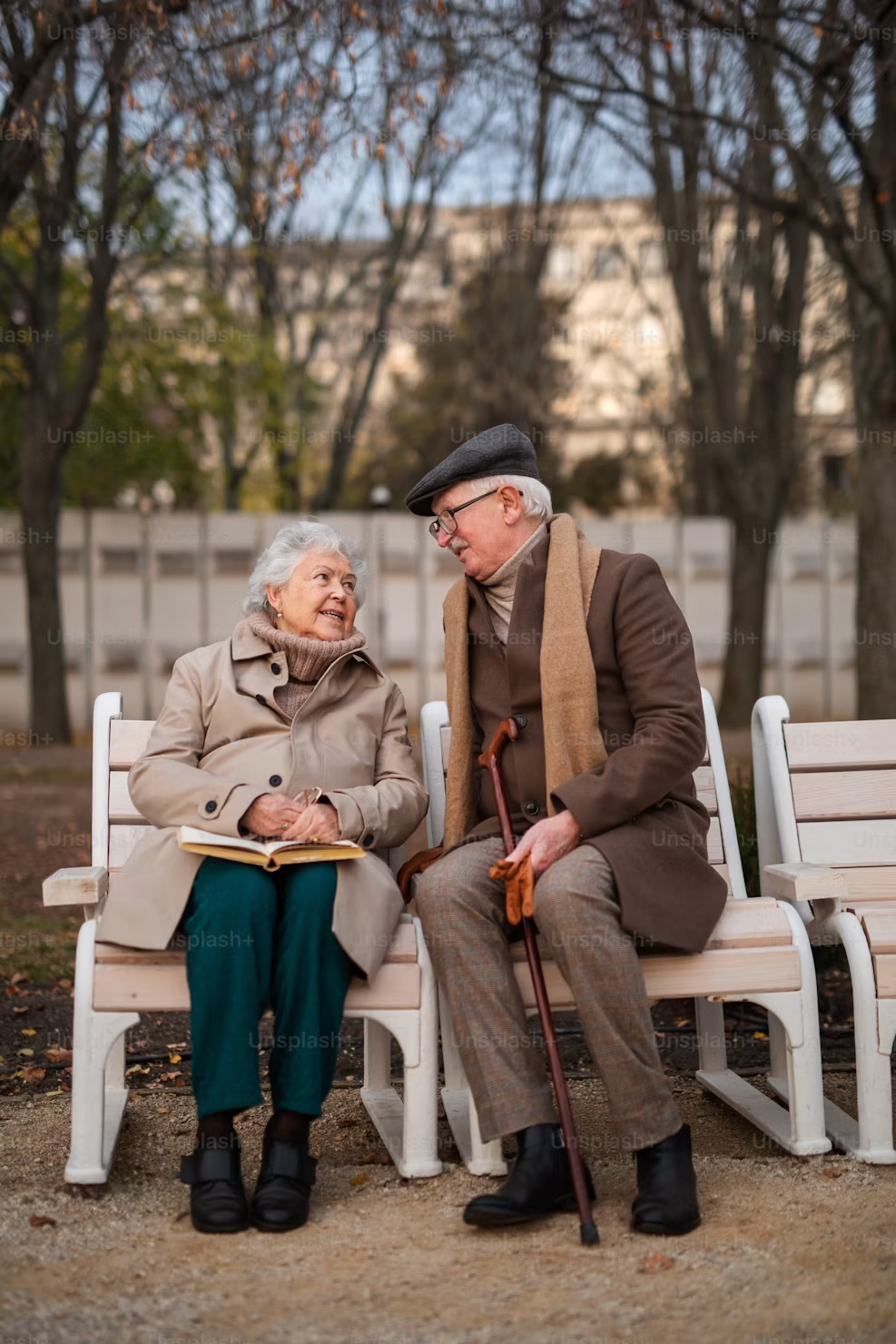
What If Technology Helped Us Stay Independent for Longer?
Britain is getting older, but the most important question is not simply how long people will live. It is how well they will be able to live during those additional years.
The Centre for Ageing Better projects that England’s population aged 65 to 79 will increase from 8.1 million in 2025 to 11.2 million by 2065. The number of people aged 80 and over is expected to more than double over the same period.
That demographic shift is normally discussed as a challenge for the NHS, social care and pensions.
It should also be viewed as one of Britain’s biggest technology and design challenges.
The objective should not simply be to create more technology for older people. It should be to use technology intelligently to help people remain safe, independent, socially connected and in control of their lives for longer.
What If We Could Prevent the Fall Before It Happened?
Falls provide a powerful example of what is already changing.
In 2024, the Department of Health and Social Care reported results from pilots of a UK-developed system called Whzan Guardian. The technology uses sensors and 4D mapping to understand movement within a room and detect falls.
Across several care-home pilots, the government reported a 66 per cent reduction in falls and approximately a 97.5 per cent reduction in ambulances called or required after falls.
Those are remarkable pilot results, although they should not yet be interpreted as evidence that every care home deploying the technology will achieve the same outcomes.
The important innovation is the shift in thinking.
Traditional care technology often responds after something has happened.
Newer systems are increasingly trying to understand what might happen next.
Your Walk Can Become a Health Signal
The way somebody walks contains information.
Changes in stride length, balance, speed and movement can potentially indicate increasing frailty or fall risk before somebody actually falls.
NHS North East London is already testing wearable technology that tracks walking and gait patterns alongside 4D sensors and other forms of unobtrusive home monitoring.
Artificial intelligence makes this particularly interesting because software can look for subtle changes across time rather than relying on a single measurement.
Imagine someone’s normal walking pattern gradually changing over several weeks.
The person may not notice.
Their family may not notice.
A carer visiting twice a week may not notice.
But a system continuously comparing movement against that individual’s normal pattern potentially could.
It might then suggest that somebody needs assessment rather than waiting for a fall to trigger intervention.
That represents a fundamental change from reactive care towards preventative care.
The Home Could Become Part of the Care System
Some of the most interesting technologies may be almost invisible.
Imagine sensors that understand someone’s normal daily routine without installing cameras throughout their home.
The system learns that somebody normally gets out of bed at 7am, enters the kitchen shortly afterwards, makes breakfast and moves around the house during the morning.
Then something changes.
One morning there is no movement.
Or somebody gets out of bed but does not enter the kitchen.
Perhaps electricity usage changes unexpectedly because the kettle, microwave or television that is normally used each morning has remained untouched.
None of those signals necessarily means that something is wrong.
Together, however, they could provide an early warning that somebody may need assistance.
This type of technology is already being explored in English social care. Redbridge, for example, has tested electricity monitoring alongside movement sensors, health-monitoring equipment and conversational AI as part of its assistive-technology programme.
The interesting design principle is that monitoring does not necessarily require surveillance.
A good system should understand enough to help without watching everything somebody does.
Healthcare Could Come to the Patient
Ageing can also create a vicious cycle.
Mobility becomes more difficult, which makes travelling to appointments harder. Missed or delayed healthcare can allow conditions to deteriorate, making mobility and independence even more difficult.
Remote healthcare can help break part of that cycle.
The government announced a significant expansion of remote NHS monitoring in November 2025, with dozens of areas across England using digital technologies to allow patients to report health information from home directly to specialist teams.
When fully operational, the government estimates that the programme could free up as many as 500,000 appointments each year.
For older people, the opportunity is particularly significant.
A blood-pressure reading, oxygen level, weight measurement or symptom update does not always require a journey to a hospital.
Some information can travel instead of the patient.
That does not mean replacing face-to-face medicine.
It means being considerably more intelligent about when physical attendance is actually necessary.
Could Technology Help Tackle Loneliness Too?
Independence is not simply physical.
It is social.
Someone can be perfectly safe inside their home and still experience profound isolation.
Technology can potentially expand the boundaries of that home through video communication, online communities, interactive entertainment and immersive technologies.
Virtual reality is particularly interesting because it can create experiences that may be difficult to access physically.
Someone with limited mobility could virtually visit a museum, experience a familiar location, explore another country or participate in an activity with other people.
The NHS has already developed 360-degree virtual-reality resources for care settings, although these are currently primarily designed for workforce education rather than as a proven treatment for loneliness.
Research into VR for older adults is promising, particularly around engagement, wellbeing and social connection, but the evidence is not yet strong enough to claim that VR itself “solves” isolation.
The bigger opportunity is designing technology that helps people maintain meaningful human relationships rather than simply giving them another screen.
The Most Important Technology May Be the One Nobody Notices
There is an important principle emerging across these examples.
Technology for ageing should not require somebody to become a technologist.
An 85-year-old should not need to understand machine learning to benefit from an algorithm detecting changes in their gait.
They should not need to configure an Internet of Things network to benefit from a home that can identify unusual movement.
They should not need to understand cloud computing to speak remotely with a healthcare professional.
The complexity should sit underneath the experience.
That is where good design becomes as important as good engineering.
Britain’s Digital Divide Creates a Serious Problem
This is also where the technology story becomes more complicated.
Millions of older people remain digitally excluded.
The Centre for Ageing Better’s State of Ageing 2025 estimates that approximately 3.5 million people aged 65 and over do not use the internet at home.
The problem is not simply broadband availability.
Some people have internet access but lack confidence or digital skills. Others do not own appropriate devices. Some struggle with accessibility. Others are concerned about scams and online security, while some simply do not want their lives to become digital.
That creates an important warning for innovators.
We cannot solve the challenges of an ageing population by creating services that exclude the people most likely to need them.
A brilliant health application is useless to somebody who cannot confidently operate a smartphone.
The best ageing technology may therefore require almost no digital interaction from the person benefiting from it.
We Should Design for People, Not Stereotypes
There is another danger in talking about technology and ageing.
Older people are not one homogeneous group.
A healthy and technologically confident 70-year-old may have completely different requirements from a 70-year-old living with multiple health conditions.
Some people in their eighties use smartphones, banking applications and video calls every day. Others do not use the internet at all.
Age alone therefore tells designers remarkably little about someone’s capabilities.
Good ageing technology should adapt to individuals rather than designing around stereotypes about what an “elderly person” looks like.
That means involving older people directly in designing the technology.
The question should not simply be what engineers believe older people need.
It should be what older people themselves say would make their lives better.
Where Is the Opportunity for Innovators?
The emerging market is much bigger than another emergency pendant.
| Opportunity | What Technology Could Do |
|---|---|
| Predictive falls prevention | Identify changes in gait, balance and movement before a serious fall occurs. |
| Ambient home intelligence | Detect meaningful changes in everyday routines without continuous camera surveillance. |
| Remote healthcare | Allow appropriate monitoring, consultations and follow-up care to happen from home. |
| Medication support | Provide reminders and identify patterns suggesting medication may have been missed. |
| Social connection | Help people maintain relationships and participate in communities despite mobility limitations. |
| Accessible interfaces | Create voice, touch and ambient systems that require minimal technical knowledge. |
| AI care coordination | Help carers and families identify which changes require attention rather than overwhelming them with alerts. |
| Smart-home adaptation | Allow lighting, heating, doors and other household systems to adapt to changing physical needs. |
| Digital inclusion | Build simpler devices, training and assisted services for people who are currently excluded. |
| Privacy-preserving monitoring | Identify risk without turning somebody’s home into a surveillance environment. |
The most valuable products could combine several of these capabilities.
A sensor alone is not the innovation.
The opportunity is the intelligence layer capable of understanding what the sensor means and determining when somebody actually needs help.
The Ethical Challenge Is Enormous
There is also an uncomfortable question underneath this technology.
How much surveillance should somebody accept in exchange for independence?
Imagine an AI system monitoring your movement, sleeping patterns, electricity consumption, medication and health information every day.
That could keep you safer.
It could also create one of the most intimate datasets imaginable.
The solution cannot simply be telling older people that surveillance is necessary for their own protection.
People should understand what information is being collected, who can see it, why it is needed and how long it will be retained.
Where possible, systems should process information locally, minimise unnecessary data collection and alert carers to meaningful changes rather than continuously transmitting everything somebody does.
Independence without privacy is not really independence.
The UKBT Institute Opportunity
Ageing is exactly the kind of challenge that demonstrates why innovation cannot happen inside individual disciplines.
A computer scientist might build the prediction algorithm.
A physiotherapist understands movement and falls.
A gerontologist understands ageing.
A social-care professional understands how care actually works.
An architect understands how physical environments affect independence.
A cybersecurity specialist understands the risks of putting sensors throughout someone’s home.
A UX designer can create an interface somebody can actually use.
Older people and carers understand something equally important: what living with these systems feels like.
Bringing those perspectives together changes the question from asking what technology we can build to asking what kind of later life we want technology to help create.
That is precisely the type of interdisciplinary challenge the UKBT Institute exists to explore.
The Bigger Picture
Britain’s ageing population should not automatically be framed as a crisis.
The Centre for Ageing Better makes an important point in its State of Ageing 2025 research: millions of people are living longer and healthier lives, while profound inequalities mean that others experience much poorer health and wellbeing as they age.
Technology cannot remove those inequalities by itself.
It cannot replace carers, doctors, families, communities, accessible housing or properly funded social care.
What it can do is extend human capability.
It can notice a change before a fall happens. It can allow health information to travel instead of forcing a patient to travel. It can help somebody remain connected when mobility becomes difficult. It can give carers better information without requiring them to be physically present every minute of the day.
The future of care should therefore not be a choice between humans and technology.
The opportunity is technology that allows human care to become earlier, more personalised and more effective while allowing the person receiving that care to retain as much independence as possible.
The best technology for an ageing society may not be technology that does more for older people. It may be technology that allows older people to continue doing more for themselves.